

Molting Form
a syllabus for Buckman Journal: Shed

Shed is a transitive verb; it must act on something. Shed light, shed skin, shed doubt. Again and again, I find myself most interested in works that shed form.
Artistic form is a transitive element; it must contain something. If that content is human enough, sensory enough, it will naturally resist such containment. “It may be supposed that a little bit of formalism turns away from the material body subject to finitude, but radical formalism brutally, viciously, relentlessly, and movingly will bring thought back around to it,” writes the critical theorist Eugenie Brinkema in Life-Destroying Diagrams. Like a fault in a tectonic plate, the very construction of a storytelling form creates the potential for its rupture.
Many of the works of art I consider most personally defining build strict structures specifically to heighten tension between form and content. They facilitate the collapse of their own storytelling rules at single molten instants. These instants transcend the limitations of oppression, memory, and time, revealing the bright, insolvent body at their core. Here are a few such stories of eruption.
First Reformed (2018, dir. Paul Schrader)
Synthesizing the cinematic language used by the canonical directors Yasujirō Ozu, Robert Bresson, and Carl Theodor Dreyer, Paul Schrader defines “transcendental cinema” as “a repeatable ritual which can be repeatedly transcended.” His 2018 film, First Reformed, serves as a thesis in this course of study in the masters, with its form and story enacting a repeated rite of enclosure around its protagonist, the Reverend Ernst Toller (Ethan Hawke).
Toller is the head of a small New England church with a dwindling flock. His parishioner, Mary (Amanda Seyfried), introduces him to her climate activist husband, Michael (Phillip Ettinger), who agrees to meet with Toller to placate his wife’s concerns about his health. In their harrowing wrestling match of a conversation, he unloads untold years of climate despair onto the pastor. Two days later, Michael takes his own life. Haunted by the double burden of Michael’s ghosts and his own (Toller lost a son in Iraq), the minister spends the rest of the film on a spiritual search for the same sense of grace he tried to offer the spent activist: “Wisdom is holding two contradictory truths in our mind…. hope and despair.” He finds the latter everywhere he turns, in the corrupt church and corrupted landscape around him. For most of the film, the former comes only in tepid glimmers of connection with a mourning Mary.
According to Bresson, “The subject of a film is only a pretext. Form, much more than content, touches a viewer and elevates him.” Schrader and his cinematographer Alexander Dynan chose a visual form without camera moves, leaving the frame as stark and unmoved around Toller as the walls of his church. Narrowed to a 4:3 aspect ratio and lit by winter cloudlight that feels like interior fluorescents, and interior fluorescents that feel like the dead whites of God’s judgement, these images hold fast around Hawke.
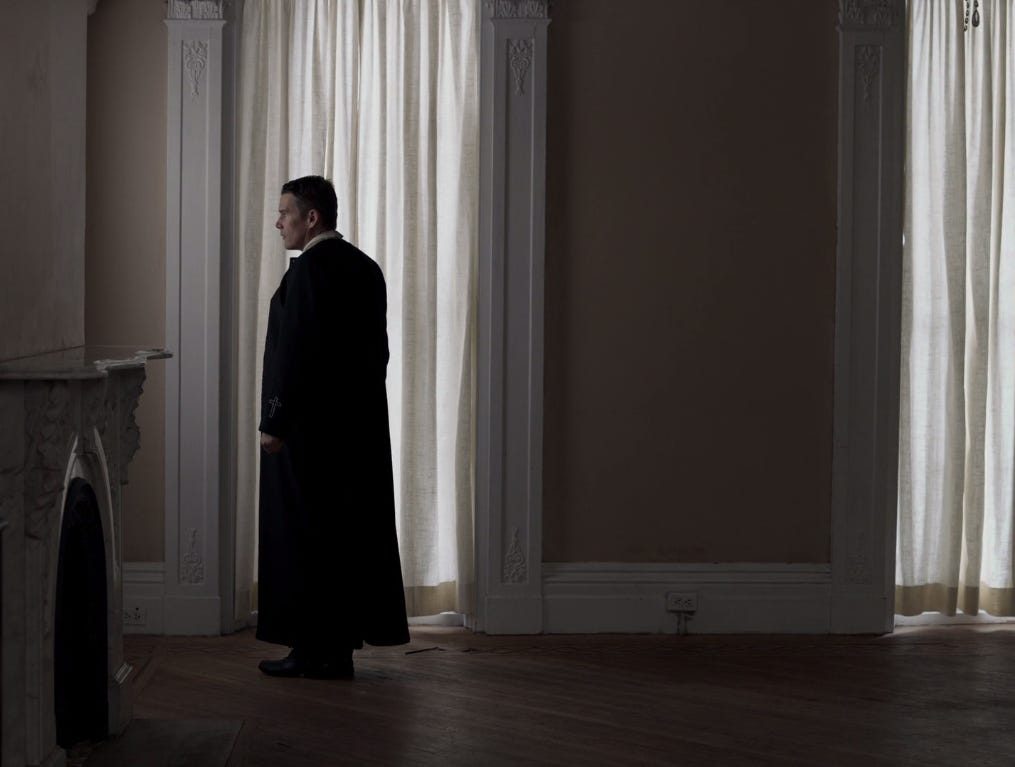
In the style of his cinematic heroes, Dreyer and Bresson, Schrader’s shots trap and scour their subject: a wide-eyed Hawke, searching the edges of the image for an escape from his spiritual despair. This desperate performance follows in the tradition of Renee Falconetti in Dreyer’s The Passion of Joan of Arc, an equally claustrophobic re-telling of Joan of Arc’s trial and execution for heresy. First Reformed inverts Joan’s passion play; instead of bearing the burden of God’s testaments, Toller bears the burden of God’s silence. Where Dreyer’s close-ups hold tight to Falconetti’s anguished face as Joan holds to her faith, Schrader frames Hawke almost exclusively in static wide shots of sparse environments, emphasizing Toller’s lostness.
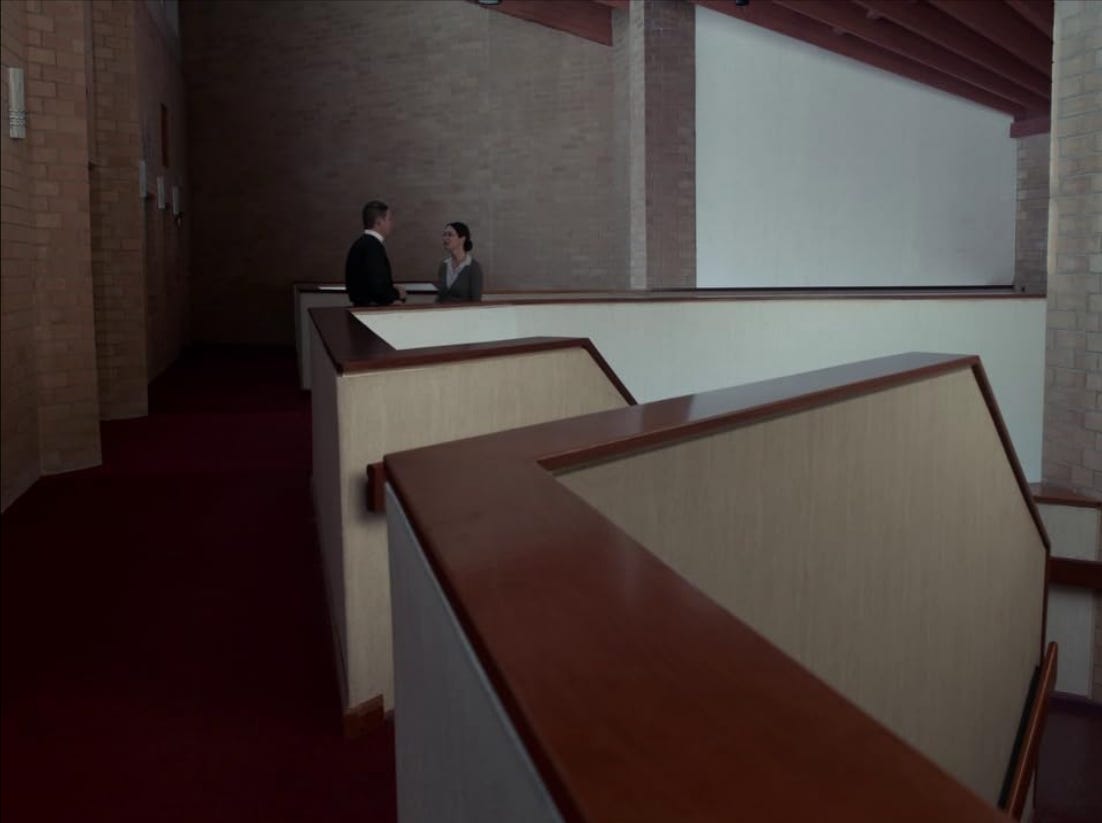
Each time First Reformed breaks from its tripod-march through static shots of harshly lit cement and clapboards and moves its camera, it comes as a shocking relief. Each of the film’s three camera movements is tied to Ernst’s blooming feelings for Mary—once on a shared bike ride, once in a moment of physical comfort. But Schrader saves his most surprising shedding of visual style for the final shot of the film, after Toller decides at the last moment not to bomb his own church during a service attended by an industrial climate criminal. Seething with rage and helplessness, the minister flagellates himself with a strand of barbed wire from the church’s decrepit yard and pours himself a glass of Drano. The camera coldly surveils him, unmoved as ever. Glass in hand, he turns to see Mary in the rectory doorway. Her voice speaks his name, but her lips don’t move. He runs to her, they embrace, they kiss, and the camera spins and does not stop but cuts to black.
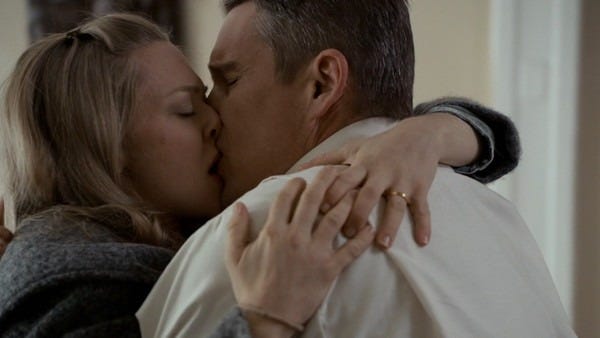
The story ambiguity here—whether Mary’s inexplicable appearance is a sexual fantasy, or a dying dream, or meant to be taken literally—almost doesn’t matter. “Form much more than content touches a viewer.” By shedding its static sequencing in favor of this new, dynamic, dream-logic visual language, Schrader implies that Toller has transcended his spiritual despair, even as he has embraced it completely. That his liberation comes just after his self-ruination seems to fulfill the pastor’s own advice to Michael; by opening himself to complete despair, he has also opened himself to world-altering hope. Two contradictory truths, finally allowed to exist simultaneously.The film sheds its own rigid formalism and moves from the claustrophobia of non-answer towards a more fluid unknown in a moment of grace that feels like the inevitable product of all that impossible despair.
Beau Travail (1999, dir. Claire Denis)
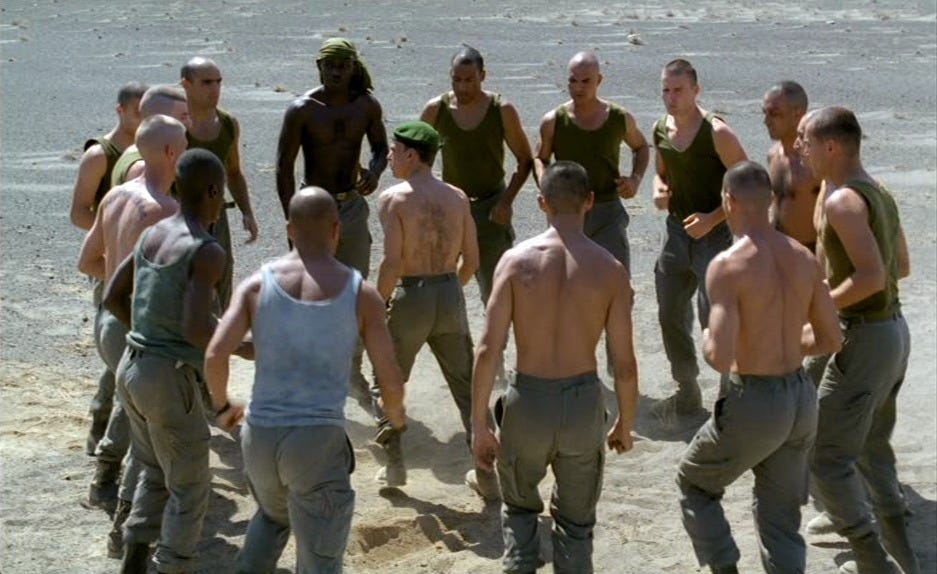
The inverse of First Reformed’s claustrophobic style, Beau Travail features bodies oppressed by limitless space. Claire Denis’ hypnotic adaptation of Herman Melville’s Billy Budd, Beau Travail tracks a band of Foreign Legionnaires as they patrol the open desert of Djibouti in an endless sequence of training drills. This baroque but meaningless choreography brings the tyrannical second-in-command Adjudant-Chef Galoup (Denis Lavant) into contact with new recruit Giles Sentain (Grégoire Colin), who immediately usurps Galoup as the favorite of their troupe’s commanding officer, Commandant Forestier (Michel Subor). Maddened by an unknowable well of jealousy that never touches the implacable crags of his face, Galoup drives Sentain far out into the salt flats and leaves him for dead.
Denis maintains the essential tension of Melville’s novella, in which discipline belies the unknowability of the souls behind the bodies who enact it. “Nobody is present—” Melville wrote of Billy Budd’s central tragedy, “none of the ship’s company, I mean—who might shed lateral light, if any is to be had, upon what remains mysterious in this matter.” In both stories, there is only the unrelenting overhead sun of the desert, of the sea, of the rules.
Matching her form to these rules, Director Claire Denis and cinematographer Agnès Godard keep their camera in constant languid motion, capturing the driftless apathy of a colonial power. Actors move across these roving frames like ballet dancers, graceful and controlled, packaged in sweat that gleams in the sun and marks the deep backdrops of blue sky and dry ground as their territory. The murderous potential of their bodies is ritualized and abstracted into a simple perpetual-motion machine, one driven by sublimated desire (Forestier practically licks his lips as he watches his new recruits cavort), but with no room for Galoup’s violent outbursts.
Again, the unbroken repetition of cinematographic form leads us to a moment of terminal despair in its final sequence. After betraying Sentain, Galoup is court-martialed and sent back to France where he complains that his “muscles are rusty.” The camera, still roving, follows closely as Galoup neatly makes his civilian bed and lies down on top of the wrinkleless sheets. He reaches for a gun and holds it to his belly, which expands and contracts slowly with his breath. The image moves up to the tattoo on his breast, which reads “sers la bonne cause et meurs” (serve the good cause and die), and down his arm to where a single muscle twitches in the soft light falling in through the window. Unerring in their target, the movements of Denis’ images—always bright, always kinetic—seem to have circumscribed Galoup’s unknowable soul.
The film’s ecstatic final shot returns us to mystery. Denis locks her frame in place in a dark and empty corner of a Djiboutian nightclub, outside of time. Galoup, uncharacteristically out-of-uniform in a black shirt unbuttoned to his sternum, sways with a cigarette. Corona’s “Rhythm of the Night” plays. He paces, turns, paces. Pirouettes. Opens the rock wall of his face and grins to himself through a mouthful of smoke. His movements get looser. He sashays. He dances, and then he is past dancing, past frollicking, past verbs, into something hunched and frantic, flailing and free. The camera sits frozen in the corner, as if astonished, for once unable to track his movements.
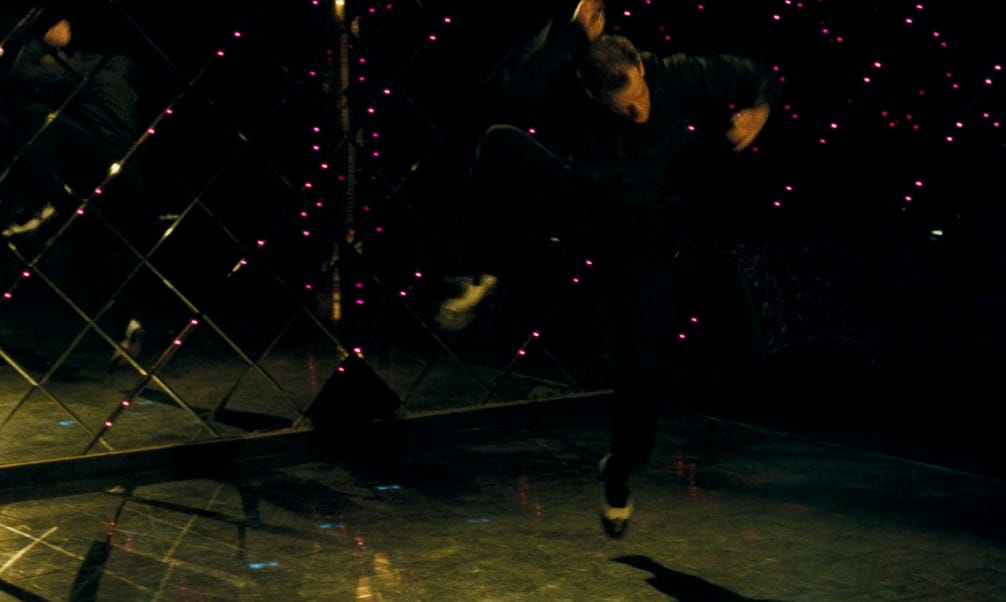
This iconic ending, often listed amongst the best in cinema history, derives its power as much from the circus-trained Lavant’s unforgettable physical performance as from the way it veers from the visual style of the film that precedes it. Beau Travail’s metronomic fluidity breaks into a wild and unclassified static shot, a box still and dark enough to reveal just a hint of lateral light. Like Ernst Toller, Galoup sheds the radical formalism he is contained in, and offers us a glimpse into the sublime ambiguity of the human subject.
“It’s Raining Today” (1969, Scott Walker)
“It’s Raining Today,” is one long wrung nerve with a pinch in the middle. Hung across Angela Morley’s discordant string arrangement, Scott Walker’s glum baritone and flat lead guitar trudge through another rainy day at the beginning of Walker’s 1969 album Scott 3.
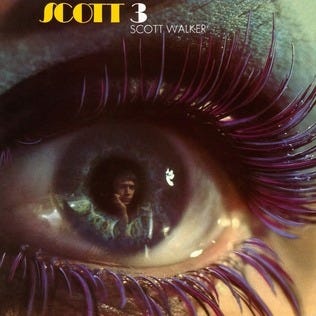
The dissonance mounts as Walker yearns for a lover who he can feel disappearing from memory (“it’s raining today, and I’m just about to forget”). The strings remain monotonous, grating against his voice as he mourns, “once there was summer and you.” His grief is a horror-tinged violin over the plodding mundanity of the guitar, of the rain. He croons, “these moments descend on my windowpane,” and suddenly the loss is too great to bear and the strings shriek into a descending glissando that vividly embodies streaks of water dashed against glass—a short moment of swelling sounds, operatic and hopeful.
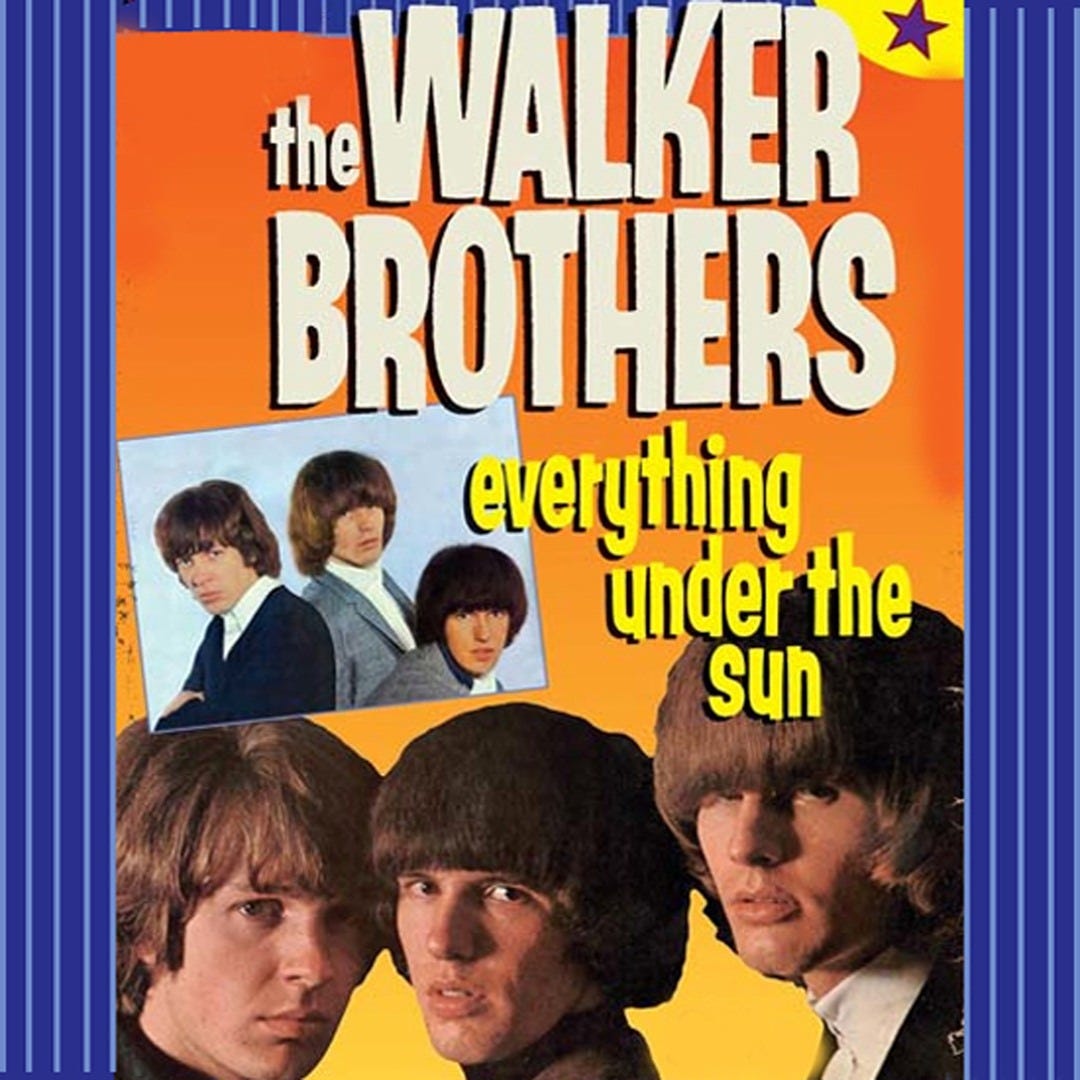
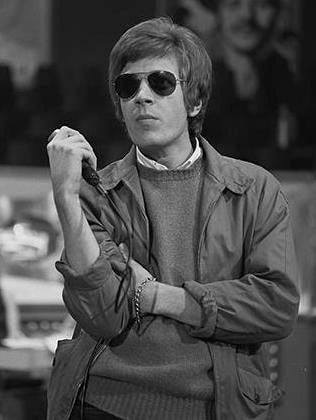
“I’ve hung around too long,” Walker announces after shedding the opening’s weary dissonance for this new triumphal sound. He carries all the naive determination of an eighteen-year-old ready to take the world by storm, which is who “Scott Walker” (born Noel Scott Engel) was in 1961 when he met the two other members of the pop trio, The Walker Brothers. Together, they spat out a string of sunny break-up ballads like “No Regrets” and “Make it Easy on Yourself.” Here, at the top of his much more abrasive solo album, Scott seems to be reaching back for the bright feeling of this earlier work, both mocking and longing for a similar simplicity of feeling.
The song turns when Walker realizes it’s time to “go like lovers/to replace the empty space/and repeat our dreams to someone new.” Suddenly, the writhing strings are back, the lead guitar settles back into its plodding; Walker sings of the mirages of “cellophane streets.” The limitless rupture of a new crush returns to its inevitable ending of dissatisfaction and loss. But what haunts, unforgettable despite its consignment to memory, is that moment of glissando, that giddy descent from irreconcilable pain into nostalgic possibility: that stark and unrepresentable image of the windowpane streaked with rain. A song Ernst Toller would love, one that succeeds in containing both absolute dejection and absolute liberation, in a way that strengthens each.
La Jetée (Chris Marker, 1962)
Chris Marker’s experimental film La Jetée is also concerned with the movement of image through time, which is another way to describe cinema, which is another way to describe memory.
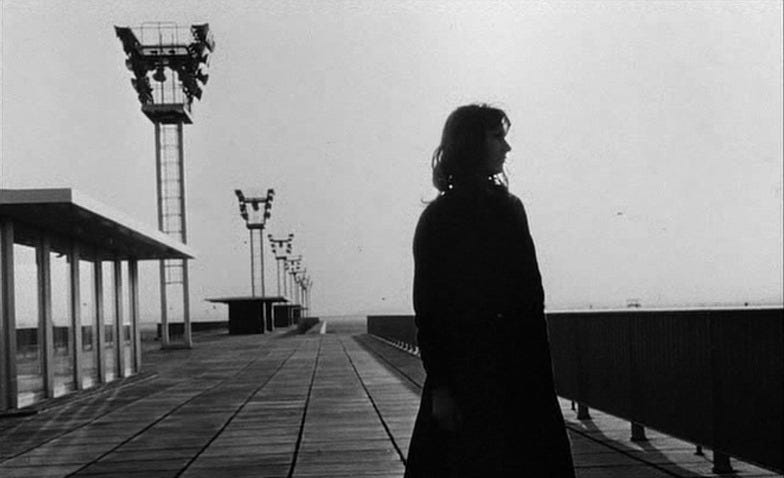
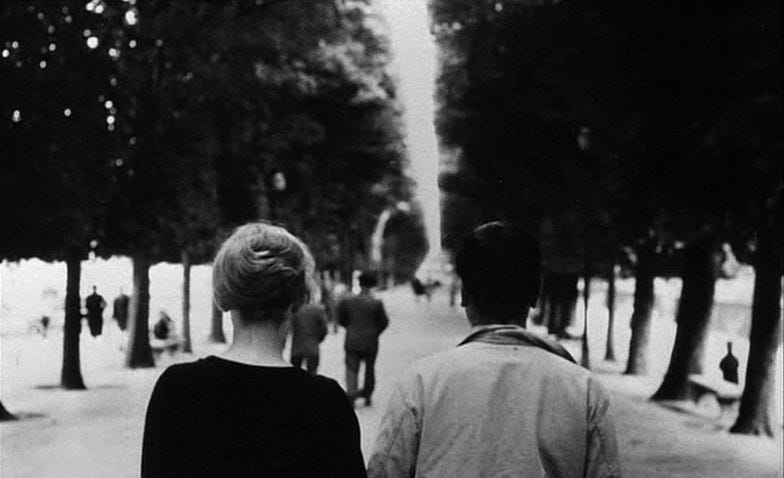
La Jetée adopts the form of a photo-roman, or photo novel, a sequence of still images that linger on the screen for seconds at a time, instead of the 24 frames per second we are used to seeing as motion on screen. This high-art flipbook tells the story of a man from a post-apocalyptic future obsessed with a single face from his childhood: a woman he glimpsed on a pier (jetée) just before he witnessed a distant figure being shot to death. His obsession with this traumatic moment makes him the perfect candidate for an experimental time travel program. He doesn’t make it back to the pier, but he does reunite with the woman he saw there, in a time before his city was destroyed. Through his repeated trips back to the pre-apocalypse, the two fall in love.
Here, Marker interrupts the slideshow of his photo-roman form for the space of a single breath: an intimate close-up of the woman whose image the narrator has so coveted, which moves momentarily at 24 frames per second, conjuring motion instead of just jerkily implying it. The effect is a chilling depiction of the reality-distending effects of love, the way a memory of a lover can be saturated with such impossible detail that it behaves like an entirely different medium.
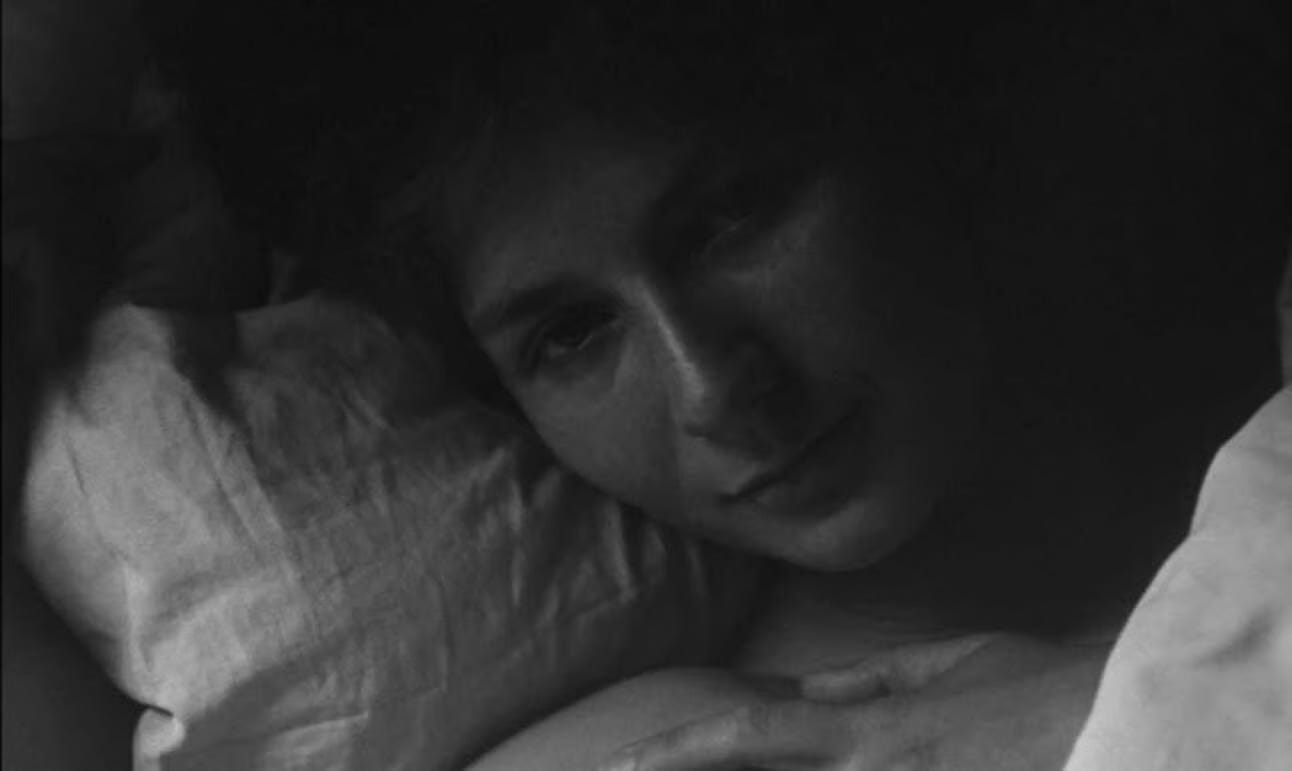
Marker knows that these moments are doomed to time, that their resistance to forgetting is what makes them both true and impossible to process, and that searching for someone new only brings us back to that first breakthrough moment. “Nothing tells memories from ordinary moments,” says the narrator. “Only afterwards do they claim remembrance on account of their scars.”
After returning successfully from a mission to the future, the man is set to be executed, his purpose within the experiment fulfilled. (“Serve the good cause and die.”) He flees into the past and finally makes it back to the pier, only to realize that the death he witnessed as a child was his own. His desire, upon which the entire story and form of the film turns, is inextricable from his mortality. This ending recontextualizes the formal rupture of his lover’s moving image. If each individual photo in the photo-roman is another inch towards his own doom, then that breath reads like a sidewise acceleration, a jetty in time, super-saturated against linearity.
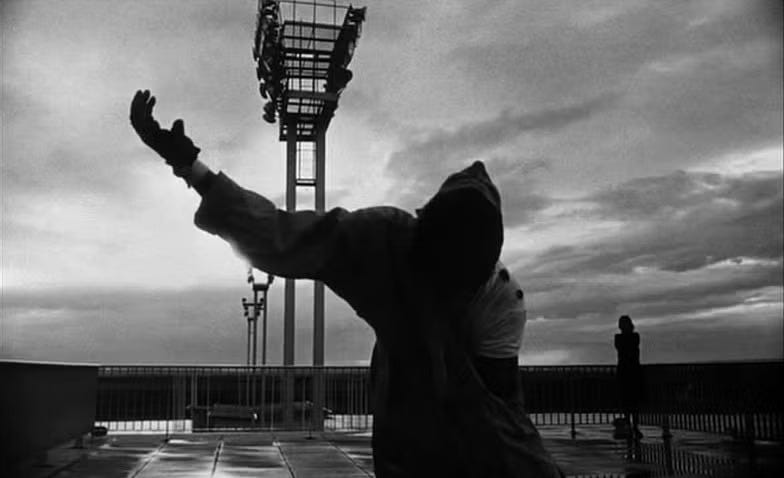
All four of these pieces perform such a swerve away from death (Toller and Galoup from suicide, Walker from aging and forgetting), and even if their escape is ambiguous or temporary, the intensity of these moments resists the sequentialism of their mediums, haunting well past when their images have been replaced.
Maybe Bresson is exactly incorrect; maybe content, “the material body subject to finitude,” is the only thing capable of touching an audience (or maybe this is a “two contradictory truths” situation). Rigid rules about how we move the camera, how sound moves against itself or images move against time, naturally open onto the sublime mysteries and paradoxes of experience when the rules reach their logical limits—death, or love, or one disguised as the other—and force us, thrilled and terrified, to shed them for something with different rules.
Why am I so enduringly obsessed with these works of formal construction and implosion, repression and renewal?
To be born into the imperial core of late capitalism is to be born into something like a radical formalism. As part of the dominant perspective, the way I was taught to see the world lined up almost directly with the way it actually worked. I understood myself as a productive part of a rational system, a rational form. But I felt an undercurrent of something displaced, some larger need repressed.
As an audience, we expect to project onto characters. But I think we can project even more powerfully onto forms, onto modes of seeing and of languaging that seeing. I relate to Ernst Toller’s struggle to balance hope against despair, but I feel that relation on a deeper level in the way the structure of Schrader’s storytelling sheds itself to spin around Mary. I relate to this gleeful upending of perspective, and I feel liberated by its irrepressible sense of possibility.
“So it was all just a joke my head played on me? Hell. Hell was just a joke I could unbelieve?” writes the poet and leftist scholar Jackie Wang. “In the poem, what was it I said? You do/you do undo.” I am drawn to these doings that precipitate undoings, because I have lived one.
Marx said that capitalism carries “the seeds of its own destruction.” So too, the forms that so rigidly govern the worlds of these despairing narrators. Schrader, Denis, Walker and Marker remind us that the creation of a form is arbitrary, no matter how inevitable it may feel, and that by shedding the forms forced upon us, we can create previously unimaginable new spaces for love and contradiction and mystery.
Works Cited
Brinkema, Eugenie. Life-Destroying Diagrams. Durham, NC: Duke University Press, 2022.
Denis, Claire, dir. Beau Travail. 1999.
Dreyer, Carl Theodor, dir. La Passion de Jeanne d’Arc. 1928.
Engels, Frederick, and Karl Marx. “Address of the Central Committee to the Communist League.” 1850.
Maker, Chris, dir. La Jetée. 1962.
Melville, Herman. Billy Budd, Sailor (An Inside Narrative). Chicago: University of Chicago Press, 1962.
Petrusich, Amanda. “The Weird and Vast and Periodically Devastating Music of Scott Walker.” The New Yorker.
Schrader, Paul, dir. First Reformed. 2018.
Schrader, Paul. Transcendental Style in Film. Berkeley: University of California Press, 1972.
Walker, Scott. “It’s Raining Today.” On Scott 3. Philips Records, 1969.
Wang, Jackie. Alien Daughters Walk into the Sun. Los Angeles: Semiotext(e), 2023.