

On Crying
after Kira Lynn Cain's Tears Are Everywhere

by Emmi Greer

Tears are indeed a constant. We’ve named them basal, this sort that’s always present. They are for your eyes. Here to lubricate, nourish, protect; to enable sight and visual clarity. They stay around renewing themselves, confident in their composition—well-bonded enzymes, lipids, and electrolytes. What distinguishes these maintenance tears is their omnipresence, but also that they remain adhered to the eyeball, are not in the business of spilling. Think of them as baseline tears, attached to the eye they belong to. They do not leave. Being constantly released in small, reliable quantities; though this can add up to four or five ounces every day. All tears are already an alchemy of water, oil, and proteins, each drop self-emulsified. Inner mucus, main water middle, and outer oil, a barrier that prevents evaporation to keep the eye in its moisturized habitat. Ideally, these necessary tears get perfectly dispersed across the cornea by each blink. But these days we’re suppressing this process, one that’s supposed to be part of a subconscious set of homeostatic functions. Our distractions have become so sticky that our gaze can’t help itself. The digital facsimiles we’ve become so beholden to acting upon our modern bodily operations. To delay a blink as long as possible is de rigueur now, a symptom of the unbroken scroll, one of many. “Screen apnea” is a similar physiological side effect, holding one’s breath while wandering, destinationless, through the worldwide web wilderness. Not only does this diminish your breath, it takes your tears away.
In the bottom of our brain still exists the tundra, the sabertooth stakes our precursors came up in, which has an inherently difficult time coexisting with the reality our species now inhabits: one where our survival does not require full-time vigilance. We can afford to tune out that utmost awareness and become, at times, just a pair of eyes, open to their stimulus.
According to familial legend, I made my mortal entrance “sunnyside up.” Babies are supposed to be delivered facedown, but ever the observer, I insisted on seeing more than the floor for my first image. Through the portal of my mother, I came across the threshold wide-eyed, refusing to be “corrected.” Strangely, I wasn’t screaming, just staring.
In concert with that lore is my seventh cranial nerve, a doctor asking, “Do you know you blink at different times?” And I did. There was evidence. In pictures, posed and candid, a subject is typically either spot-on with eyes open or eyes closed, both of them. But me, I’m split, one eye blinking at a time, photographic proof of the small, sequential delay. So technically, I’ve never not been watching. Since birth, only in sleep is my body not keeping at least one eye open. It would be easy to theorize about vigilance, caution—but I like to tell myself it says more about perception, the art of noticing. Look.
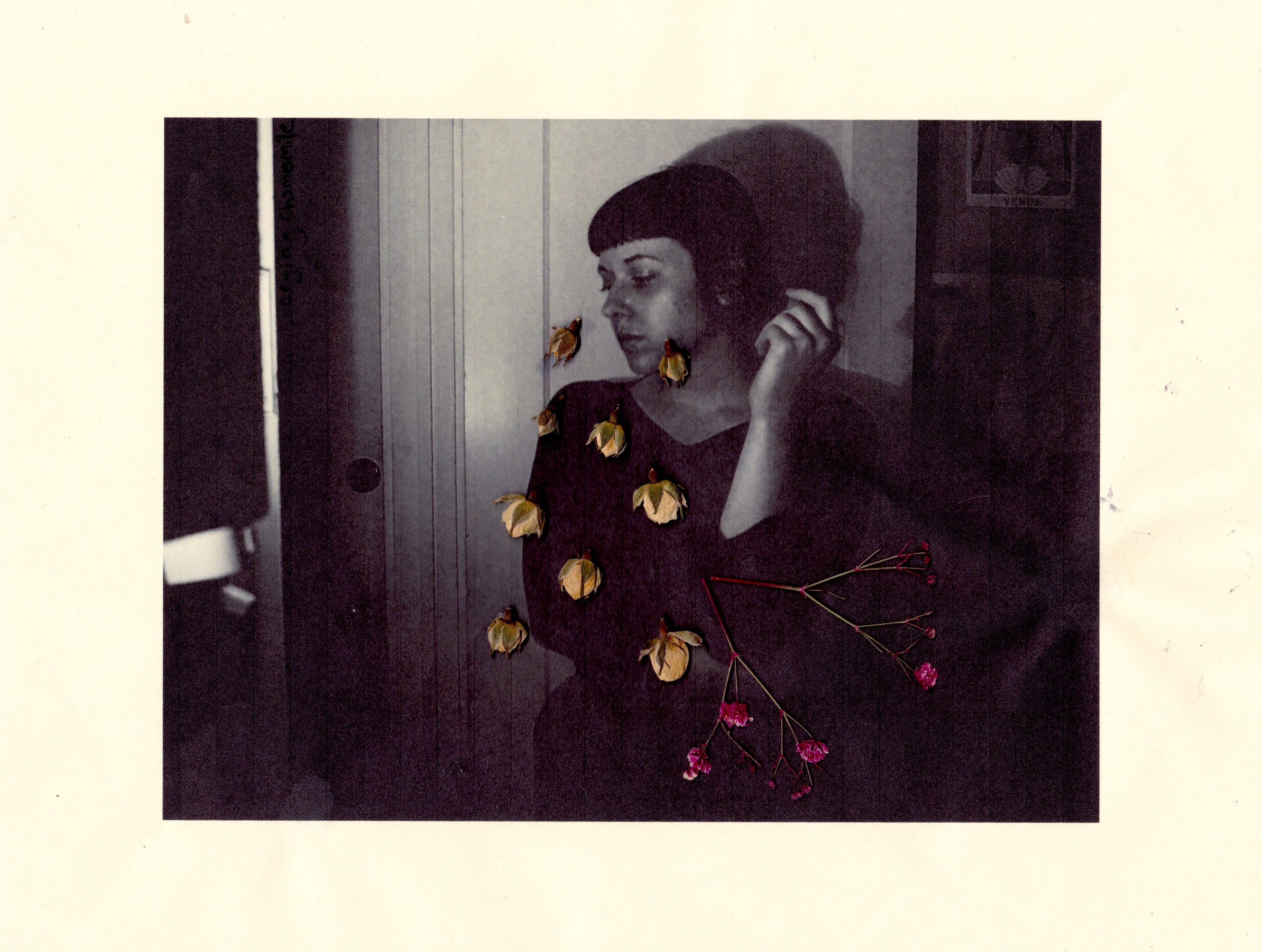
REFLEXIVE
If basal tears are a film, reflex tears are a definitive flow. They are produced in response to irritants and come in sudden and large volume to flush away potential harm. Reflex tears are waterier, made to flood, douse out any danger to the face. This liquidity is what lets them leave the eye and stream as they please. They pool forwards. They’re a reaction of environment, offering an intermittent, versatile protection. Capsaicin. Wind. Fumes. Smoke. Malic acid. Allium vapors. A volatile gas wafts up from the onion, meets the natural water in your eyes and turns to sulfuric acid on contact. Your vision wobbles, washes. Put the knife down. The tears rush to clear their ecosystem. Grass and dirt can drink them.
Like me, you might remember eyeball dissection day: a science class touchstone to cut out the cornea, lens, and retina of a preserved bovine eyeball. Sharing a scalpel with your lab partner, the formaldehyde aura making our own eyes water. We have the dedicated chords and glands. The tears and us are coexisting.
The membrane is surprisingly durable. I always open my eyes underwater, goggles or not. Again with the looking. You see them secretly.
As a child, I found a few-inch stowaway of cattail stem hidden perfectly underneath the curve of my eyeball from some roughhousing at the neighborhood pond. Pulling it out incredulous. My eye was trying to tell me, watering for days.
Reflexive tears are packed with immune compounds and antibacterial properties. This came in handy for my eyes with all the stress styes I used to get. Whatever gland gotten infected before whatever race or exam. I’d have to lie down with teabags on my lids. Praying to the tannins as whichever eye trickled.
Since then, I’ve gotten accustomed to this type of light gush. The chronic migraines I’ve had since puberty are often accompanied by a not-quite crying. What I call leaking, but only from one eye, the erratic weather of my right hemisphere.
PSYCHIC
These are the sort that sets us apart, that only humans are known to produce. They have several names: psychic, psychogenic, or “emotional” tears. I might describe them as a strong feeling that transforms, somehow, into a bodily function. They occur in vastly different frequency and volume across our species, in varying degrees of voluntary. Their very existence is sui generis, with a one-of-one manifestation in each body they emit from.
Their make up too, is signature: oilier, holding more protein than other tears; this causes them to roll slower, theoretically making more opportunity to be seen. An evolved viscosity. But we hardly heed that biological imperative—to be publicly viewed shedding them. Somewhere between ecstatic biblical weeping and the numbed stoicism of 2026 A.D., we started apologizing for tears.
As an adult, how many times have you heard, “I told myself I wasn’t going to cry,” as if that prior agreement seals bodily obedience. As if the words are a spell to ward off any assumption that despite the presence of genuine emotion, the tears were not invited, not wanted in that moment, context, at least. They are another day’s tears.
It had been a bit of a catchphrase of mine for a while, a clever little inversion I’d wield: if someone was misty-eyed, or on the verge and sorry about it, I’d tell them they had nothing to apologize for and follow, rhetorically, with “have you ever warned someone before you laughed?” Because this disclaimer seems to be specific to tears. As a lifetime member of the frequent criers club, the practice is not new for me, but the conceiving of them not as a primarily private habit is a learning curve I’m still on. Alone tears.
The tears’ bid for witness seems obviously intelligent to me; in this case, as an inter-bodily signal. I imagine that the basal and reflex tears sprang among hominids for quite a while. All apes still use the first two types of tears. The tears that evolved within us, watering often from all the cave fires as we went. Emotional tears must have come on later. A mysterious biologic technology, perhaps tears are a result of our sapien proximity that speak to the interdependent condition. Saying silently, in their way, that perhaps whatever the overwhelming feeling, when brought into the communal present, can be tempered, made more bearable. Tears in a crowd: clockwork.
Maybe tears are the great regulator, announcing, simply, that something needs to be felt. Whether it originated in you or not; as we know tears are tugged by internal and external stimuli.
There is a clear division in how the experience of crying is viewed, understood widely as both a melodramatic experience that summons distress, and as a soothing behavior that dissipates distress. Most every moment, for me, is inflected with its opposite and so this either/or rings not as suspect, but doubly true.
Personally, I do indeed do it in bouts of overwhelm, mercurial despair, and acute grief, but just as much in contrast—not when you might think: while dancing, cleaved by a euphoric pop song. That’s a maximalist cry. While toasting my beloveds at the dinner table. That’s a bourgeois cry. Tears on hands. Playing my own life’s montages in mind’s eye. Tears in pictures. That’s a triumph cry, nostalgia-fed. Tears in pockets. While watching TV, the commercial during, even. That’s a Hollywood cry. Spliced with self-aware laughter. That’s a multiplicity cry.
A good cry can offer psychic relief, of course, but also acts on us physiologically. Crying can lower blood pressure and pulse, enhance mood and cognition, it’s even been compared to a drug. The hormones in them. Endorphins too. Tears are a self-generated remedy that apply to both brain and body. An expressive behavior that goes where language often cannot. It’s both pre and post verbal. A portal to the parasympathetic. It’s hypothesized that tears are a waste product of the nervous system. A soft purge of sorts, sobbing out neurotransmitters.
There are times when it feels entirely serene, graceful even. Gravity having its way with the droplets. I cry and am pleased with my capacity, my availability to being moved, melted. Appreciate a willingness to react to my landscape, the people around me, the currents inside myself. But other times it’s grueling, rising volcano-like from the chest. Erratic inhalations and exhalations. Little tapers and collapses. I might tremble, shake. Still, I heed the tears: let it get worse and then a little better, at least. The sorrow that was so ecstatic just to be seen.
For me, tears are likely to come and go throughout any given day, but there are also endurance cries: so sustained and difficult to know when the unit, that particular cry, is complete. And I might have an idea why it’s happening, but very likely, a cry cannot be attributed to just one thing. It’s a cumulative experience. See the crying forest through tears of the trees above. Gluing eyelashes into little wet triangles, isosceles.
If you think it’s just wallowing, then insert what might be obviously said about fragility here, weakness. But I see tears as an emissary of something more like compassionate pain, representing the emotional wherewithal required to embrace it. The Bible describes tears as the heart’s water, literal leakage of what keeps you alive. Definitions of wallowing include: 1. to roll about or lie in water, snow, mud, dust, or the like, as for refreshment 2. to surge up or billow forth, as smoke or heat 3. to live self-indulgently; luxuriate; revel. Damn, don’t those all sound good? So how did that word get the reputation it has? In this case, the wallowing is seen as unproductive and self-pitying, an unnecessary dredge. This is part of a paradigm that supports tears not as waste but as a waste.
As a teenager, my first time at a therapist, she kicked off our session by asking, “Is there an experience that brings you to tears and can you share it with me?” I wonder now: what did that prompt tell her? Was it issued to everyone? And if so, how many couldn’t conjure a tear at all? A chronic overachiever, this was the test I was most suited for by far, and it was also the first possible inkling that there was therapeutic value in allowing, inviting them out even. Tears, you are welcome here.
The object of those tears, my first great love, a shockingly philosophical jock-cum-choir boy who quoted Voltaire in our senior yearbook told me, a year earlier, upon first seeing me cry, “You’ve never been more beautiful to me than you are right now,” to which, already heaving, I cried harder.
Now I brag about my teary tendencies, being otolaryngially easy, an intermittent fountain. Though I wouldn’t have back then. But it also took me quite a while to realize I was an above average crier, because that’s all I had reference for. I’m still the leakiest person I know. Hit the lacrimal jackpot, I guess. At best, I could be called an empath. At worst, emotionally incontinent.
I do admit to having only partial volition in it, between feeling that first isopropyl prickle and having full eyes fixing to overflow. I’m doing it while I type this. Multitasker. I decorate my home so I look good crying in it, tonight I broke in my new couch by weeping on it. I cry outside so the stars can see me. Tears in the sky asleep, asleep.
Some might see it as a tool, that I could cry on command and use tears in my favor. To get out of a parking ticket. Or on a stage. Plenty of actors struggle with this. You can go chemical and resort to menthol if you can’t summon tears yourself, but calling on a charged memory is often the method. Although the best trick I know for faking it, and it never fails, is to cover your face and laugh. Because the bottom half actually belies the act of crying more than the eyes, which may be wet, squinting, but a true cry, like a true poem, occurs in the throat, as evidenced by the fact that the one thing you definitively cannot do while crying is sing.

Very likely, when I mention the name David Lynch, the associative next step might be a disembodied ear or other imagery that signifies his haunting, signature surreality. But this core fascination with the disturbing undercurrents of humanity manifested only in his art. The other context in which his name is widely known is as chief ambassador of TM™ (Transcendental Meditation.) The David Lynch Foundation brings the meditative technique to every harmed and hurting demographic you can think of: veterans, domestic abuse survivors, the currently and formerly incarcerated, to name a few. These populations are sought out, the practice taught at no cost as a catch-all solution, a seemingly reliable instrument of inner peace. Spreading this healing technology was a vision DL pursued with equal or greater prolificity as his creative practices, despite its utopian bent that might seem at odds with the shadowy nature of his films. Rather than seeking to disturb, his foundation revolves around offering comfort, overcoming suffering, and multiplying repair. I want to call it Lynchian, but that term’s already been coined, known to reference the cinematic, dark, and depraved. But in my view, just as Lynchian is the exuding of lightness, ease, and transcendence. So the question, exemplified in his life’s efforts, arises: doesn’t it seem necessarily entangled, that we can’t have one end of the emotional spectrum without the other? That curiosity for the human condition goes in both directions? I wanted to hear this considered, possibly confirmed from someone outside myself and thought him an authority. Alas, they cut the Q&A off as I was about to take the mic with the wording I’d workshopped all weekend. The person in line in front of me indulging in a non-question monologue ruined it for the rest of us, but I suppose that’s as good an answer as any. Tears in pages. They do not talk.
Consider the modern sociology of tears. The few designated spaces where it’s relatively acceptable to cry: funerals, weddings, hospitals, airports, to a degree, and here’s a big one: celebrity award ceremonies. It’s unsurprisingly gendered, and we’ve studied it that way. All the statistics about frequency, duration, and intensity tip towards women. Only 7% of them report not having cried for a whole year or more. While that number is 35% for men according to data from a few years back. I can hardly imagine twelve or thirteen moons without any tears at all. So an imaginative framework in which tears are timeless and ubiquitous is liberating, reparative, endearing. To know tears. Know them everywhere.
On the grassy retirement home median. In the principal’s office. Many a backseat. The shower’s a cliché setting, now; rain too, but I stand by that one. In the church pew. The studio. Near my childhood bedroom, not in it. Under a willow, in traffic, from a stoop, at the strip mall, the museum, the casino, the graveyard. Concert front row. Listen, sounds of invisible tears.
The self-reported range is somewhere between five and sixty-five cries per body per year. So I know I’m wealthy in them, lifetime-supplied with millions of individual tears. Last year I cried eighty-three days in a row, maybe more, but stopped keeping the official log. It was part rigor, but mostly the natural course of things after a particularly potent grief streak. I not only acknowledged tears, but anticipated and coaxed them, started always keeping spoons in the freezer for a swollen face, buying tissues in bulk, switching to waterproof ink after too many notebook pages were smeared by their drip. Adding to the sadness admixture. In those early aftermaths of loss, there’s not only the shock and ache of absence, but the cell-deep confusion of having crossed into a badlands where what was once love now presents as agony. I had to maintain at least a daily cry to get ahead of the grief. Shed some preemptive tears at home to hedge against spontaneous meltdown while out in the incongruous world. As a Roland Barthes character astutely explains:
“I make myself cry, in order to prove to myself that my grief is not an illusion: tears are signs, not expressions. By my tears, I tell a story, I produce a myth of grief, and henceforth I adjust myself to it: I can live with it, because, by weeping, I give myself an emphatic interlocutor who receives the “truest” of messages, that of my body, not that of my speech: ‘Words, what are they? One tear will say more than all of them.’”
Tears have become just another process, a somatic mechanism I have total trust in. I might only ask that the salty lament be more widespread. If tears are the overarching water system, when we cry, we’re just doing our part in percolation. Our ebbs and flows are oceanic, saline. Tears in the sea, slowly up, silent down. But also estuary, far-reaching irrigation. It’s a good dissolution. Waterworks.
The only downside, truly, the main point I couldn’t convince you on, is the risk of loneliness, thus the importance of learning to cradle ourselves through tears. Whose arms better to be held by. There you reside. The self-soothe curriculum that accompanies childhood does not continue into adulthood as it should. Seeing tears all over as an antidote to this. Precipitation is just part of life on earth. Outside of its idiom, we are all, literally, underneath the weather and can find solidarity in bearing it together.
Neural circuits specific to crying have yet to be identified. The same can be said of emotional responses in general. Though a large takeaway of Michael Pollan’s latest book, A World Appears: A Journey Into Consciousness, is that therein—the feeling—lies the rub. It’s more likely “I feel, therefore I am” than the Cartesian thinking way in. So shouldn’t expanding the range of that feeling be seen as brave, virtuous, in service of exploring consciousness at large?
There exists the same quandary here as with consciousness: are we radios or satellites, generating or receiving? I imagine the gallons from my lifetime, proud to have two small personal renewable waterfalls, regardless of where they come from.
What if tears are just a stand-in? Another attempt to get at the ineffable. The unified field, the dream vein, the mists of ancestors, what have you. Tears let you be a sieve to extrude through, part of the hydrologic system. A tear is a pawn, sent out as sacrifice. A single tear belongs to a litany, will always have back up. A tear is a reverse candle, one that lasts.
What if we cried like we did toasts? “Here’s one more for the girls back home.” With my volume and abundance, I could start dedicating them to people I know who could use one. I’d be grateful, thank and congratulate each contributing tear. Say hi to them in all their settings, then go to a mirror to see the crying on myself and declare: tears are everywhere.
Here’s two teary hours of music to keep the crying (literal or otherwise) going:

An art book for all ages, Kira Lynn Cain’s Tears Are Everywhere recently won the American Illustration Award and the Literary Titan Book Award.
“The minimalist artwork combines textured black-and-white pen lines with bright washes of color, creating pages that feel delightfully tactile yet restful. The deceptively simple poetic language invites readers to think beyond their everyday understanding of tears to how shared emotions and experiences connect us to one another and to the natural world around us.” —The Children’s Book Review
“For humans, tears indicate sadness, joy, confusion, and more, but Cain illuminates their capacity to sustain the workings of the earth and universe by showing their presence even in our responses to the intangible wonders of life, like music. All water is made of tears in Cain’s book, and her typography and illustrations beautifully complement her message that our tears, and all tears, are part of an all-encompassing water system that unifies us all.” —Editor’s Pick Booklife Review by Publisher’s Weekly
Brilliant as always!
"to which, already heaving, I cried harder." Love this piece. Multiplicity cry! Many a backseat indeed.