Q&A with Jeff Alessandrelli of Fonograf Editions
support small presses like FE via the PDX Give!Guide

Every November and December, Willamette Week’s Give!Guide brings Portland’s nonprofit community into focus, creating a campaign that encourages thousands of small donations that help sustain the city’s cultural, environmental, and social ecosystems.
For Fonograf Editions, Give!Guide is a crucial opportunity to continue our volunteer-led work bringing experimental literature, sound, and art into the world. Every donation comes with an incentive. To learn more, visit FE’s Give!Guide page.
Edy Guy: FE has renowned acclaim and international presence, garnering recognition from The New York Times, Paris Review, and other major publications, yet it remains a small, indie press. What do you credit this success to? What does this success say on behalf of independent publishing?
Jeff Alessandrelli: Fonograf Editions is indeed a small, indie press. Some of our releases have received recognition from places like The New York Times and The Paris Review, for which we’ve been very grateful. Other releases have sold sparingly, just a few dozen copies. I think our success largely stems from the fact that as editors we care the same about both the big books and the small books. Prior to founding FE, I ran a small chapbook press with my friend Bret called Dikembe Press. We exclusively published chapbooks, tape-bound, pretty cheaply produced. I loved being a part of Dikembe because it was never about scale; it was purely about putting work into the world that we loved. No one was going to get $ or fame or any of it. So I took that ethos into FE as well. And I think a lot of independent publishers are the same way. We don’t really run P & L (Profit and Loss) statements. None of us are really getting paid, at least not much—and there’s a freedom in that. At FE we think of publishing as a vocation, not a profession. It might sound trite or cheesy but it’s true.
FE publishes spoken word vinyls, which is quite niche. At the 2025 Poetry Confluence in Portland, Oregon you spoke on a panel with Rae Armantrout, co-editor Adie Steckel, Charles Valle, and Endi Bogue Hartigan about the sonic importance of literary work. Do you find that the vinyls capture something (in regard to sound) the books on their own can’t? What is that something? What’s the archival significance of publishing on vinyl?
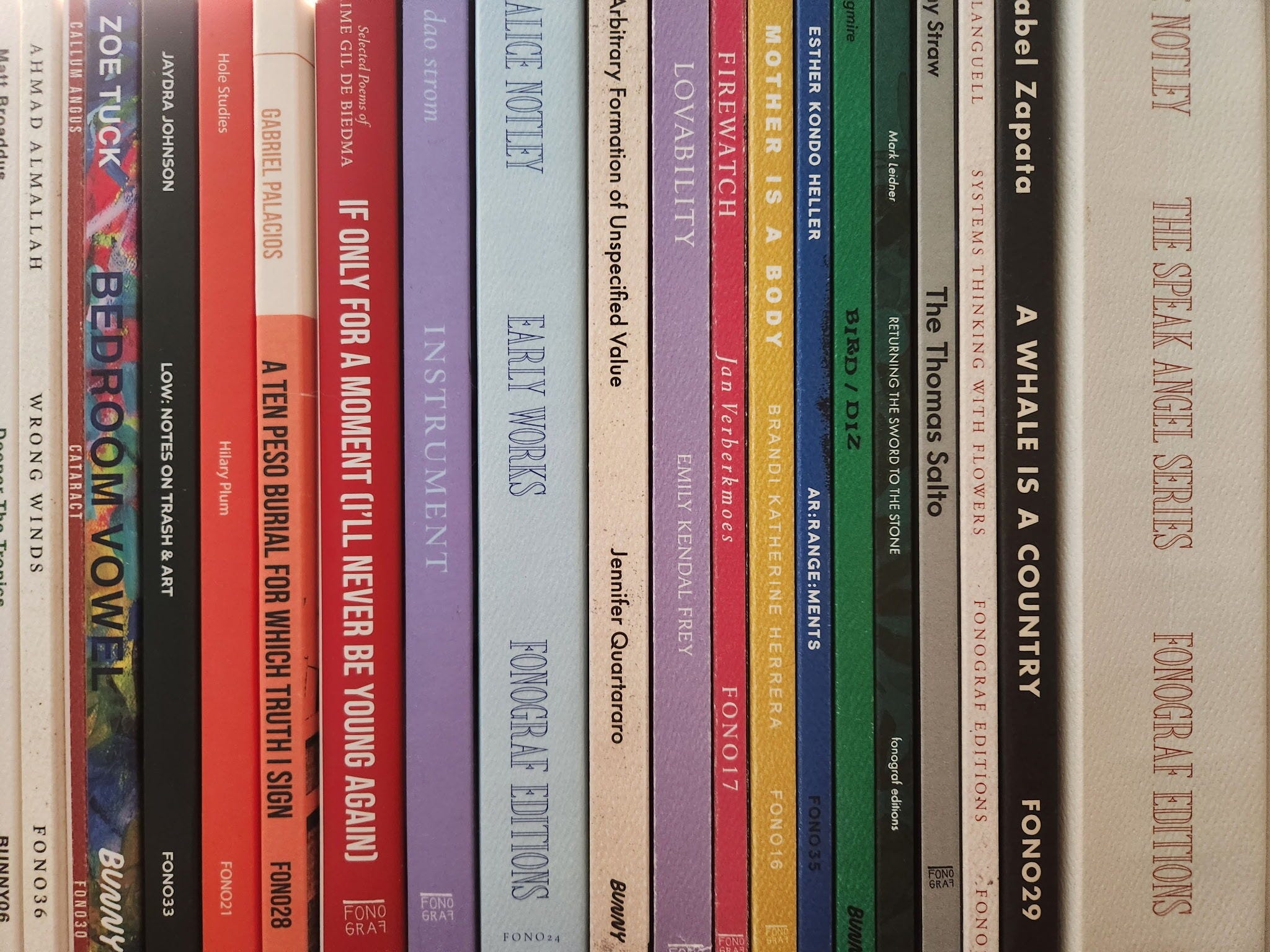
FE started out as a record label; it was an “arm” of the press Octopus Books. Our first five releases were albums by poets Eileen Myles, Rae Armantrout, Alice Notley, Harmony Holiday, and Susan Howe/Nathaniel Mackey. I grew up listening to a lot of Caedmon Records; that label and their LPs were instrumental to my development as a poet. In my opinion, yes, a poetry LP is different than a poetry book. It’s more atmospheric, more inspirational (listening and mis-listening for me often begets the start of a poem of my own), more interpretive, less focused. The listening experience can indeed be an experience if you let it; it’s different than reading a white paper/black ink poetry book.
As for the archival significance of publishing on vinyl—I’m not sure, although when I was immersed in poetry LPs, listening to Gertrude Stein or William Carlos Williams on vinyl moved me in a way that listening to them on my computer or my phone did not. It felt like a portal had opened, probably because listening to anything on vinyl is archival these days. The two archival poetry LPs that Fono has done, one by John Ashbery, the other by Audre Lorde, were hard work but super rewarding for the press. (FE editor Adie B. Steckel produced and edited those and they are lovely to hold and listen to.)
The financial component of publishing is not talked about as much as I’d like. Even large houses offer meager wages in major cities where the provided salary would place their employees at the poverty level. Many people in these roles hold advanced degrees. They are aware—and sometimes reminded—how competitive and rare these positions can be. Publishers, especially small presses, after printing, publicizing, and distributing work, are often at a net loss for their business. In consideration of these conditions, it seems that publishing is not intended as a viable career path. Are we evading entrapments of capitalism or maintaining an unstable industry and thus creating more precarity?
The more I learn about publishing the less I understand, honestly. Due to the fact that 90% of new books sell fewer than 2,000 copies—and that’s only focusing on major presses; the number is even lower for small presses—I think it is extraordinarily hard to make a living in the publishing industry. As you note it’s even harder to make it work in big cities, and people with advanced degrees are still working as junior editors, making little $ as they try and work their way up. That said, I don’t think a lot of the people interested in publishing (or writing generally) go into it to make $. (I wrote about these topics previously, here and here.)
Speaking for Fonograf Ed’s situation, we started out as a for-profit, with $16,000 of seed money that I inherited when my grandmother died. In 2018, we shifted to being a non-profit because our LPs were very much not making any $. Since then we have exclusively lived off sales and grants, and our bank account looks a little different each month. Some of our staff members now take very small monthly honorariums or get paid per project. What we can pay people is 100% not enough to live on. I don’t know what the future will hold. FE’s 10th anniversary is next year and at this point we are still mostly existing on enthusiasm. I have no idea if that will hold for another 10 years. Finally, we are also mostly a poetry press (65-70% poetry, 35-30% everything else) and one of the things about poetry that you learn early is one doesn’t make a living from it but a life. So that mentality is something that I take with me from book to book and year to year.
I hesitate to bridge this topic, but it’s omnipresent and hard to avoid: with the infiltration of AI, what opportunities and traps do you foresee for writers? Top of mind for me: I’m anticipating more stylistic innovation, harder to replicate by machines, and—since I do believe the world is organized toward some kind of balance—a return to slower means of production and consumption (print mags, etc).
I haven’t used AI very much, but when I have it’s a magic that I am, perhaps rightly, perhaps wrongly, suspicious of. The environmental impact of AI, along with the freewheeling intellectual property theft, is what worries me more than the impact it might have on actual writers. Going back in time, Plato was against writing because he—rightly—predicted that it would cause people to not use their memories as much. They would forget and humanity would become slaves to the written word. Circa 2025, I don’t think anyone would have it the other way. In the future AI might be just another tool in the ambitious writer’s toolbox. I personally think people will always value the human-made over the AI-made, but it also depends on the project/genre/situation/etc. I guess we’ll see and my mind is, at least partially, open.
You spoke with Brad Listi on the Otherppl podcast recently in response to your piece on Zona Motel about minor writers. You mentioned how 28% of Americans read at the lowest level of literacy. This is concerning and, I’d argue, organized by design of troubling politics. It also doesn’t help those of us in publishing. So, I ask you, why read?
I read to be surprised and mystified and to center my attention. Also to inspire my own work. I was a reader first and always will be, but being a writer now, what I read has a direct impact on my own writing. I don’t ever really get writer’s block because of my reading practice, which is wide and varied. I think everyone should read all the time, but it doesn’t necessarily bother me that they don’t. That said, if one wants to be a writer—any type of writer—reading is the first and only really necessary step to making that happen, and being of the old school I think books are better than reading on a screen. But that’s just me.